



Acadia vs Pilot
The 2019 GMC Acadia Compared with the 2019 Honda Pilot
How does the all-new 2019 GMC Acadia compare to the 2019 Honda Pilot?
Let the experts at Lester Glenn GMC in Toms River, NJ introduce you to the advantages of driving home in a new 2019 GMC Acadia!
Safety
The Acadia Denali’s optional pre-crash front seatbelts will tighten automatically in the event the vehicle detects an impending crash, improving protection against injury significantly. The Pilot doesn’t offer pre-crash pretensioners.
For enhanced safety, the GMC Acadia’s middle seat shoulder belts have child comfort guides to move the belt to properly fit children. A better fit can prevent injuries and the increased comfort also encourages children to buckle up. The Honda Pilot doesn’t offer comfort guides on its middle seat belts.
The Acadia has a standard front seat center airbag, which deploys between the driver and front passenger, protecting them from injuries caused by striking each other in serious side impacts. The Pilot doesn’t offer front seat center airbags.
When descending a steep, off-road slope, the Acadia SLE/SLT’s optional Hill Descent Control allows you to creep down safely. The Pilot doesn’t offer Hill Descent Control. The Acadia Denali offers an optional Surround Vision System to allow the driver to see objects all around the vehicle on a screen. The Pilot only offers a rear monitor and front and rear parking sensors that beep or flash a light. That doesn’t help with obstacles to the sides.
Both the Acadia and the Pilot have standard driver and passenger frontal airbags, front side-impact airbags, side-impact head airbags, front seatbelt pretensioners, front-wheel drive, plastic fuel tanks, four-wheel antilock brakes, traction control, electronic stability systems to prevent skidding, daytime running lights, rearview cameras, available all-wheel drive, crash mitigating brakes, lane departure warning systems, blind spot warning systems and rear cross-path warning.
Warranty
The Acadia’s corrosion warranty is 1 year longer than the Pilot’s (6 vs. 5 years).
GMC pays for scheduled maintenance on the Acadia for 2 years and 24,000 miles. GMC will pay for oil changes, lubrication and any other required maintenance (up to 2 oil changes). Honda doesn’t pay scheduled maintenance for the Pilot.
There are over 64 percent more GMC dealers than there are Honda dealers, which makes it much easier should you ever need service under the Acadia’s warranty.
Reliability
A hardened steel chain, with no maintenance needs, drives the camshafts in the Acadia’s engine. A rubber cam drive belt that needs periodic replacement drives the Pilot’s camshafts. If the Pilot’s belt breaks, the engine could be severely damaged when the pistons hit the opened valves.
To reliably power the ignition and other systems and to recharge the battery, the Acadia has a standard 150-amp alternator (155-amp - Acadia V6 and 170 V6). The Pilot’s 130-amp alternator isn’t as powerful.
J.D. Power and Associates’ 2018 Initial Quality Study of new car owners surveyed provide the statistics that show that GMC vehicles are better in initial quality than Honda vehicles. J.D. Power ranks GMC 20th in initial quality. With 3 more problems per 100 vehicles, Honda is ranked 23rd.
Engine
The Acadia’s optional 3.6 DOHC V6 produces 30 more horsepower (310 vs. 280) and 9 lbs.-ft. more torque (271 vs. 262) than the Pilot’s 3.5 SOHC V6.
Fuel Economy and Range
The Acadia AWD’s standard fuel tank has 2.2 gallons more fuel capacity than the Pilot (21.7 vs. 19.5 gallons).
Brakes And Stopping
The Acadia’s standard front and rear disc brakes are vented to help dissipate heat for shorter stops with less fading. The rear discs on the Pilot are solid, not vented.
The Acadia stops much shorter than the Pilot:
- Acadia | 60 to 0 MPH | 126 feet stopping distance
- Pilot | 60 to 0 MPH | 128 feet stopping distance
Tires and Wheels
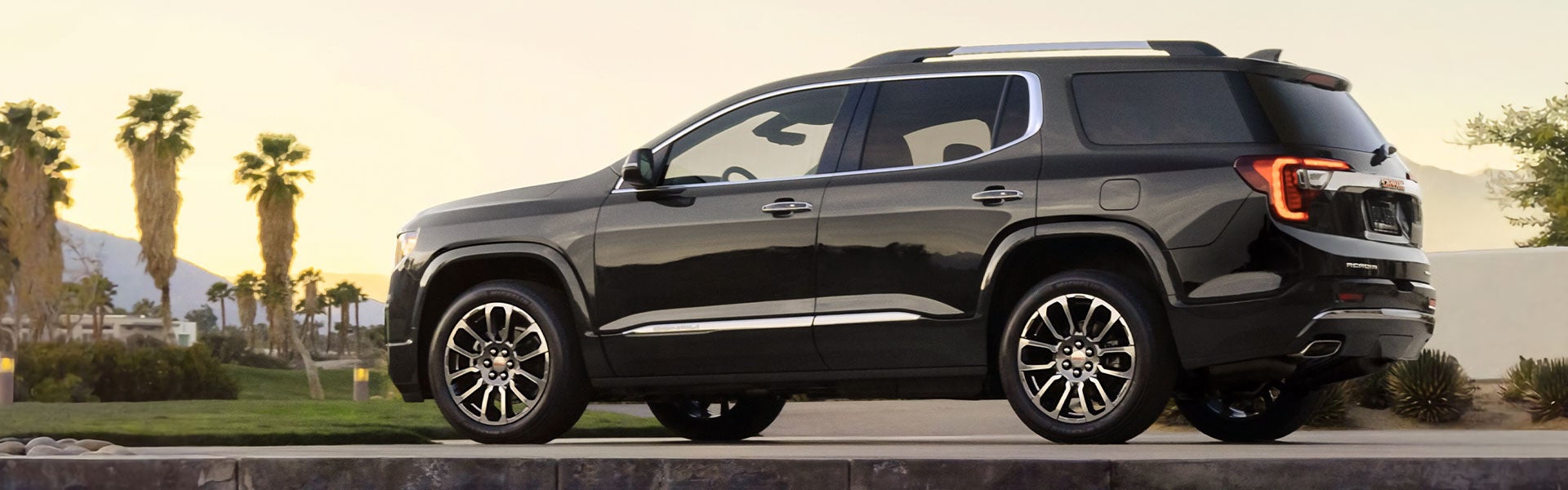
For better traction, the Acadia’s optional tires are larger than the largest tires available on the Pilot (255/65R17 vs. 245/60R18).
The GMC Acadia’s wheels have 6 lugs for longer wheel bearing life, less chance of rotor warping and greater strength. The Honda Pilot only has 5 wheel lugs per wheel.
Suspension and Handling
The Acadia offers an available driver-adjustable suspension system. It allows the driver to choose between an extra-supple ride, reducing fatigue on long trips, or a sport setting, which allows maximum control for tricky roads or off-road. The Pilot’s suspension doesn’t offer adjustable shock absorbers.
For a smoother ride and more stable handling, the Acadia’s wheelbase is 1.5 inches longer than on the Pilot (112.5 inches vs. 111 inches).
The Acadia Denali AWD handles at .85 G’s, while the Pilot Elite 4WD pulls only .80 G’s of cornering force in a Car and Driver skidpad test.
The Acadia SLT AWD executes Motor Trend’s “Figure Eight” maneuver quicker than the Pilot Elite 4WD (26.9 seconds @ .67 average G’s vs. 27.8 seconds @ .62 average G’s). For better maneuverability, the Acadia’s turning circle is .7 feet tighter than the Pilot’s (38.7 feet vs. 39.4 feet).
For greater off-road capability the Acadia All Terrain has a greater minimum ground clearance than the Pilot (7.8 vs. 7.3 inches), allowing the Acadia to travel over rougher terrain without being stopped or damaged.
Chassis
The front grille of the Acadia FWD 4 cyl. uses electronically controlled shutters to close off airflow and reduce drag when less engine cooling is needed. This helps improve highway fuel economy. The Pilot doesn’t offer active grille shutters.
Passenger Space
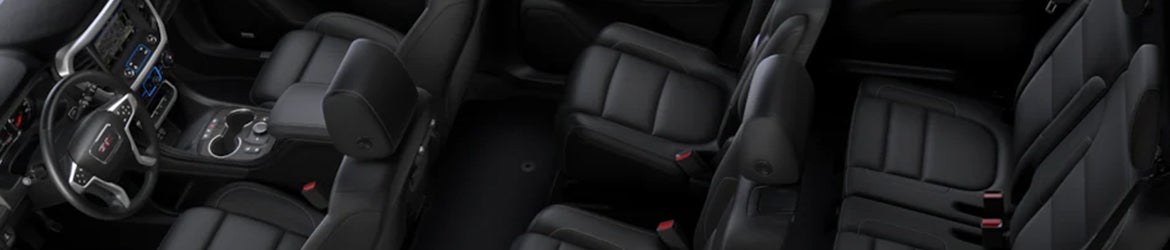
The Acadia has .2 inches more front headroom, .1 inches more front legroom and 1.3 inches more rear legroom than the Pilot.
Cargo Capacity
Pressing a switch automatically lowers the Acadia’s second row seats, to make changing between passengers and cargo easier. The Pilot doesn’t offer automatic folding seats.
Servicing Ease
The Acadia uses gas struts to support the hood for easier service access. The Pilot uses a prop rod to support its heavy hood. It takes two hands to open the hood and set the prop rod, the prop rod gets in the way during maintenance and service, and the prop rod could be knocked out, causing the heavy hood to fall on the person maintaining or servicing the car.
Ergonomics
he power windows standard on both the Acadia and the Pilot have locks to prevent small children from operating them. When the lock on the Acadia is engaged the driver can still operate all of the windows, for instance to close one opened by a child. The Pilot prevents the driver from operating the other windows just as it does the other passengers.
The Acadia’s optional front and rear power windows all lower with one touch of the switches. The Pilot’s rear power window switches have to be held the entire time to lower them fully. The Acadia’s standard outside mirrors include heating elements to clear off the mirrors for better visibility. Honda only offers heated mirrors on the Pilot EX/EX-L/Touring/Elite.
The Acadia’s power mirror controls are mounted on the armrest for easy access. The Pilot’s power mirror controls are on the dash, hidden behind the steering wheel, where they are awkward to manipulate.
The Acadia has a standard dual zone air conditioning allows the driver and front passenger to choose two completely different temperatures so people with different temperature preferences won’t have to compromise. This makes both the driver and front passenger as comfortable as possible. Dual zone air conditioning is only available on the Pilot EX/EX-L/Touring/Elite.
Economic Advantages
According to The Car Book by Jack Gillis, the Acadia is less expensive to operate than the Pilot because typical repairs cost less on the Acadia than the Pilot, including $65 less for a water pump, $29 less for a muffler, $113 less for a starter, $112 less for a fuel pump and $39 less for front struts.
| Monday | 9:00AM - 8:00PM |
| Tuesday | 9:00AM - 8:00PM |
| Wednesday | 9:00AM - 8:00PM |
| Thursday | 9:00AM - 8:00PM |
| Friday | 9:00AM - 8:00PM |
| Saturday | 9:00AM - 6:00PM |
| Sunday | Closed |
| Monday | 7:00AM - 4:30PM |
| Tuesday | 7:00AM - 4:30PM |
| Wednesday | 7:00AM - 4:30PM |
| Thursday | 7:00AM - 4:30PM |
| Friday | 7:00AM - 4:30PM |
| Saturday | 7:00AM - 4:30PM |
| Sunday | Closed |
| Monday | 7:00AM - 3:30PM |
| Tuesday | 7:00AM - 3:30PM |
| Wednesday | 7:00AM - 3:30PM |
| Thursday | 7:00AM - 3:30PM |
| Friday | 7:00AM - 3:30PM |
| Saturday | 7:00AM - 3:30PM |
| Sunday | Closed |